Football has offered young people in Xinjiang a platform to be seen and prove themselves. Behind every match are stories of resilience, dreams and grassroots passion.
by sportswriters Sun Zhe and Hu Huhu
URUMQI, July 27 (Xinhua) — Yumitjan Ehmet has never kicked a football, yet the sport has transformed his life. The 23-year-old, who has used a wheelchair throughout his life due to a congenital spinal condition, is now a football content creator on Douyin with more than 10,000 followers.
In northwest China’s Xinjiang Uygur Autonomous Region, where deserts and the Gobi stretch beneath towering mountains, football has taken root like the hardy poplar trees that flourish with little water. The sport has become a shared language that brings people together and a window through which the world can see this distant land.
“Football gave me something to look forward to,” Yumitjan said. “I hope everyone can find what they truly love deep in their hearts, hold on to it, and shine.”
A NEW WINDOW
Yumitjan spent most of his childhood at home.
Watching other children leave with backpacks on their shoulders and play freely in the yard, he often felt a quiet sense of longing. For years, his world seemed confined to what he could see through a single window.
Football entered his life when he was 12. On television, he watched players weave past defenders, battle for every ball and fight for victory. The game’s passion and determination captivated him.
A year ago, Yumitjan began producing football commentary videos, analyzing tactics, writing scripts, editing footage and uploading each piece himself. A single video can take five or six hours to complete. His phone is his main recording tool, while his mother often helps behind the camera.
At first, he used only his voice and never showed his face. His brother-in-law later encouraged him, saying, “You have to accept yourself first before others can truly accept you.”
After several days of hesitation, Yumitjan finally appeared on camera. Nervous and afraid of how people might react, he posted the video anyway and received an outpouring of encouragement and recognition.
“I didn’t want people to feel sorry for me,” he said. “I wanted to be recognized for my knowledge of football, not pitied because of my illness.”
Yumitjan is among many people in Xinjiang whose hopes have been powered by football.
During a Xinjiang Super League match, Kasar Hasimjan received the ball inside the penalty area and fired it into the net, sending the crowd into celebration.
Many spectators noticed nothing unusual until he turned around, revealing that he was missing his left arm.
Kasar lost his left arm in an accident when he was 18 months old. Growing up in Atush, a city with one of Xinjiang’s strongest football cultures, he was drawn to the sport from an early age.
His parents initially worried about his safety and did not support his desire to play. Kasar, however, secretly joined his classmates on the field.
“It was certainly difficult,” said Zhao Hui, his current school team coach. “Maintaining balance in physical contact is already challenging. Without a left arm, he cannot use it to protect the ball, and opponents will try to exploit that weakness.”
He fell repeatedly, played through injuries and persisted despite his parents’ concerns. To improve his coordination, he worked to strengthen his waist and lower-body muscles.
“If others train once, I train several more times,” he said.
His speed, ball control and shooting steadily improved, making him an indispensable member of the team. Over the years, he competed in dozens of cities across China and helped his team win the National County Football Championship in 2025.
“Football is played with feet, not hands,” he said. “Whether on the field or in life, I don’t want anyone to think I am different.”
DREAMS TAKE ROOT
One night, Mirhamit Tursun walked out of his home carrying a blanket, ignoring his mother’s advice to stay inside. He wanted to spend the night on the football field he had built himself.
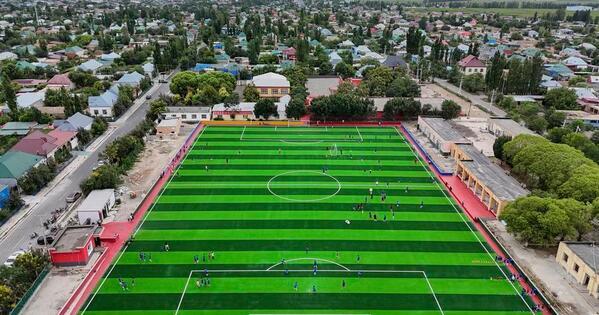
In May, the 34-year-old spent more than two million yuan (about 295,000 U.S. dollars) to build the first standard football field in Karabagh Village, a community of fewer than 4,000 residents located less than 120 kilometers from the China-Kazakhstan border.
“I was so excited because I felt my dream had finally come true,” Mirhamit said. “I didn’t have a field like this when I was a child, but the kids do now.”
As a child, he played football on riverbanks and vacant land. When he traveled with teammates to compete in county tournaments, they sometimes slept overnight in public squares, lying on blankets and covering themselves with coats before returning to the field the following day.
His passion for football later took him to east China’s Fujian Province, where he attended university and became the top scorer in a regional league. However, he also realized that passion alone could not compensate for a lack of professional training from an early age.
Mirhamit came to believe that the future of football belonged to the next generation. That conviction inspired him to save enough money to build a field for his village.
Many people considered the idea unrealistic and questioned why he did not use the money to buy a house or simply save it. Such doubts followed him throughout the project.
To finance the field, Mirhamit took on various jobs, including coaching youth football and working in land contracting. He cut costs wherever possible, skipping gatherings with friends, eating instant noodles and staying in budget hotels during business trips to keep the project moving forward.
His determination also won the support of the construction team, which helped turn his plan into reality.
His youth training camp opened this summer. Children pay around 40 yuan per day for meals and training, while those from less privileged families can attend free of charge. Some participants have traveled from neighboring counties to take part.
“I am not an outstanding player,” Mirhamit said. “But I hope this field can produce a player like Ronaldo one day, someone who can wear the Chinese national team jersey.”
FUTURE TAKES SHAPE
In May, former China national team coach Bora Milutinovic visited the region.
“Xinjiang players’ style is clearly different from players in other parts of China,” he said. “They are physically strong, aggressive in challenges and have a strong desire not to give up. These are valuable qualities, and they are not simply produced by a mature professional system.”
The Serbian coach, who led China to its only FIFA World Cup appearance in 2002, noted that many Brazilian players emerged from street football, while numerous African talents began playing on simple fields. He believes Xinjiang’s players possess a similar spirit of resilience and determination.
In recent years, players including Behram Abduweli and Umidjan Yusup have emerged from Xinjiang and reached the national team. Like countless young players across the region, they began their journeys on grassroots football fields.
Football is bringing new opportunities to the region.
Alongside individuals such as Mirhamit, local authorities have also recognized football as an opportunity for young people and increased investment in grassroots facilities. By 2025, Xinjiang had 4,936 football fields.
A broader competition system is also taking shape. School tournaments and regional leagues are providing young players with more competitive experience. This year, Xinjiang plans to organize more than 300 football events at county level and above to strengthen the sport’s grassroots foundation.
“The future of football depends on generations of young players,” Milutinovic said. “They need to build solid skills and develop a strong mindset through consistent training, whether in school teams or youth development programs.”